
News 09.12.2025
Why can't the heating transition in existing buildings wait for hydrogen?
Ralf Lanzrath
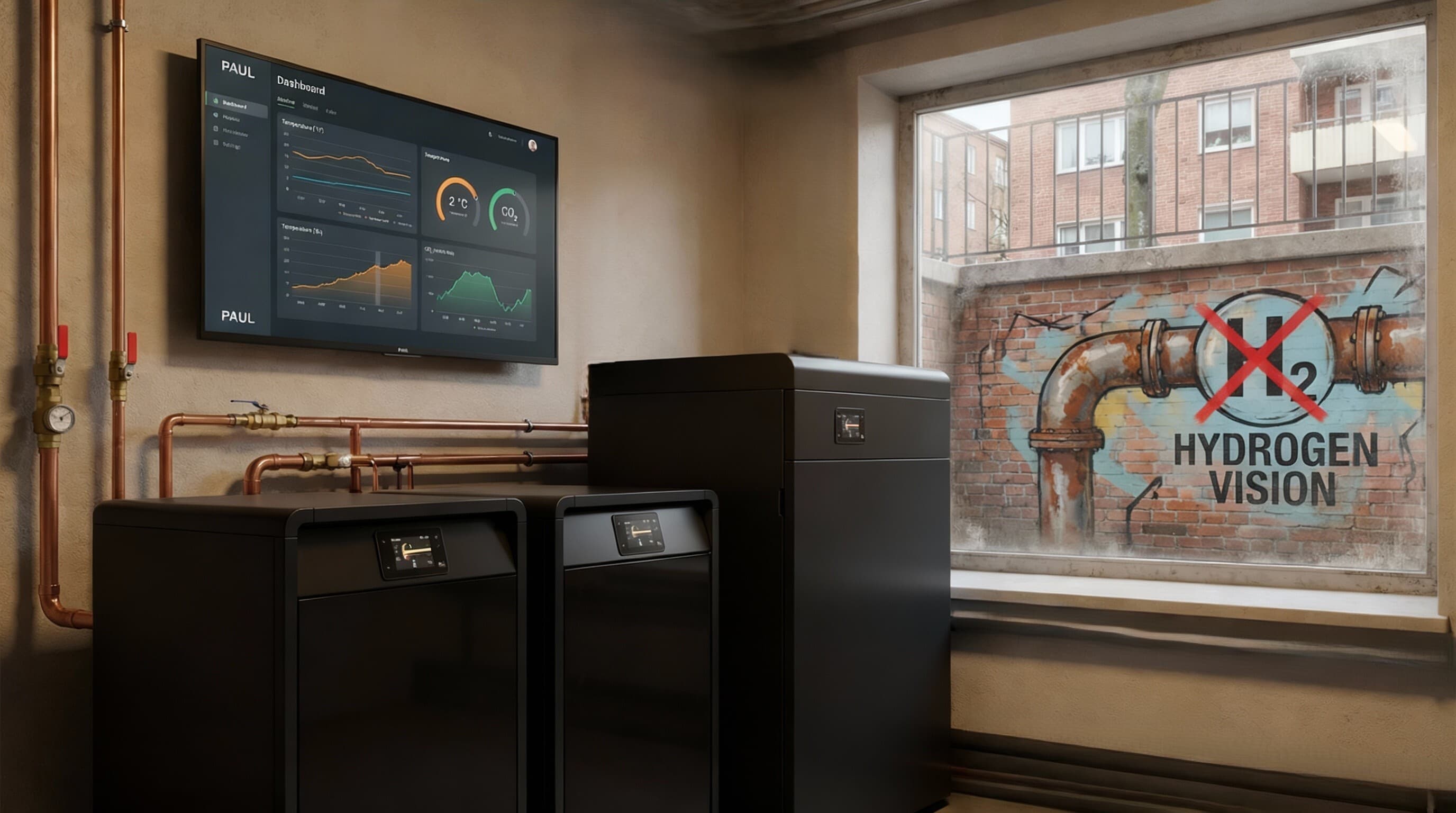
Hydrogen is losing its appeal – especially in residential heating
The ninth strategy study by the consulting firm Horvath, evaluated in the Zeitung für kommunale Wirtschaft (ZfK) newspaper, paints a clear picture:
- 90% of energy suppliers see only limited margin potential in the hydrogen business.
- Hydrogen is mainly used in industry and heavy-duty transport – it plays hardly any role in private households and passenger cars.
- The majority of companies consider the German government's H₂ expansion targets to be unrealistic and do not expect wider use until 2040.
At the same time, investment priorities are shifting significantly: district heating, large heat pumps, neighborhood solutions, batteries, and IT landscapes are moving into focus. Heat is becoming a key growth driver.

The problem: The heating transition in existing buildings cannot wait
This poses two risks for the housing industry:
- Time: It often takes 10–20 years for new heating networks or hydrogen infrastructure to be installed in neighborhoods.
- Uncertainty: It is highly questionable whether political goals, subsidy programs, and H₂ prices will materialize as planned.
At the same time, pressure is mounting due to ESG requirements, CO₂ costs, taxonomy, and tenant markets. Those who fail to act now run the risk of parts of their portfolio becoming stranded assets.
PAUL: Heat transition from the boiler room instead of from the hydrogen strategy
PAUL closes precisely this gap. Our technology platform combines:
- Real-time digital analysis of energy flow in the building
- AI-based optimization of the heating system
- Highly efficient heat pumps and photovoltaics (PAUL Net Zero)
- Contracting models without upfront investment for owners
Depending on the setup, we achieve:
- 10–30% energy savings in existing systems through PAUL Performance alone
- In net-zero projects, up to 77% less final energy and 99% less CO₂ when jumping from efficiency class E to A.
- Installation takes place during ongoing operation without entering the apartments. Instead of a large construction site, there is a smart, scalable solution in the boiler room.
Four key advantages for owners and portfolio managers
Immediately measurable decarbonization
1. CO₂ neutrality and efficiency class leap without waiting for H₂ pipelines or new district heating connections.
Predictable operating costs instead of H₂ gamble
2. More stable heating costs through efficiency, heat pumps, and PV electricity instead of unpredictable future hydrogen prices.
No capex blockade
3. PAUL refinances technology and operation from existing heating costs – budgets for renovation, purchase, or development remain free.
Future-proof your portfolio – today, not in 2040
4. Reduce ESG risks, secure valuation, and offer tenants a green, affordable heat supply.
Conclusion:
If utilities are planning to phase out hydrogen from the residential sector, that is no reason to postpone the heating transition – on the contrary. With PAUL, it can be implemented more quickly, more reliably, and more economically than with any hydrogen scenario.